Head west on I-70 past Wentzville and you will eventually hit farmland near New Florence that Google is turning into a data center. Downtown, an office building on Locust Street is being rebuilt to hold AI servers. In Midtown, the old Famous-Barr building next to the Armory is slated for a $3 billion server campus. The St. Louis data center boom is not a national story happening somewhere else. It is happening on roads you drive. So the fair question for a small business owner is: does any of this change how I run my company? A little. Less than the headlines suggest. Here is how I sort it out.
Three projects behind the St. Louis data center boom
Google's Project Spade in Montgomery County
Google announced a $15 billion campus south of I-70 near New Florence. Planning documents call it Project Spade. In June 2026 the Montgomery County Commission >approved a tax incentive package for it, and Google says it expects about 300 workers on site. Construction is already moving.
TierPoint on Locust Street
TierPoint bought an office building at >2300 Locust Street and plans to spend up to >$150 million converting it for high-density AI and GPU work. The company says a Fortune 100 tenant signed on before construction started. This is the one closest to most St. Louis offices.
TerraWatt's Midtown campus
The biggest local fight. Developer TerraWatt wants a 120 megawatt campus in the former Famous-Barr building on Market Street. On September 15, 2026, the city's redevelopment authority >gave final approval to a community benefit plan that requires renewable power and minimum hiring. Construction is planned from August 2027 to late 2029. Several plaintiffs have sued the city to stop it, and those suits were still pending at last report. I would call it likely, not certain.
Why St. Louis, and where the US vs. China race fits
Data centers need three things: land, electricity and water. The Midwest has all three at prices the coasts can't match, and Missouri offers a state sales tax exemption on data center construction that the Midtown developer plans to use.
Zoom out and this is one front in a bigger race. The US leads on advanced chips and the giant cloud companies. China has a national plan called >Eastern Data, Western Computing that pushes new data centers toward its energy-rich western provinces. Both countries are hunting for cheap power and open land. Missouri happens to have both.
That race raises a separate question: which country's laws govern the data your business already stores? It deserves its own post, so I wrote one on data sovereignty and where your business data lives. This one stays local.
What actually changes for a small business
Power costs are the thing to watch
Data centers draw enormous amounts of electricity. A >Bloomberg analysis found wholesale electricity prices rose as much as 267% over five years in some areas near data centers. Two caveats. That is wholesale, not the rate on your Ameren bill. And it describes other regions, not St. Louis. Still, more demand on the same grid is a real pressure, so it is worth tracking instead of guessing.
Your software vendors pay for servers too
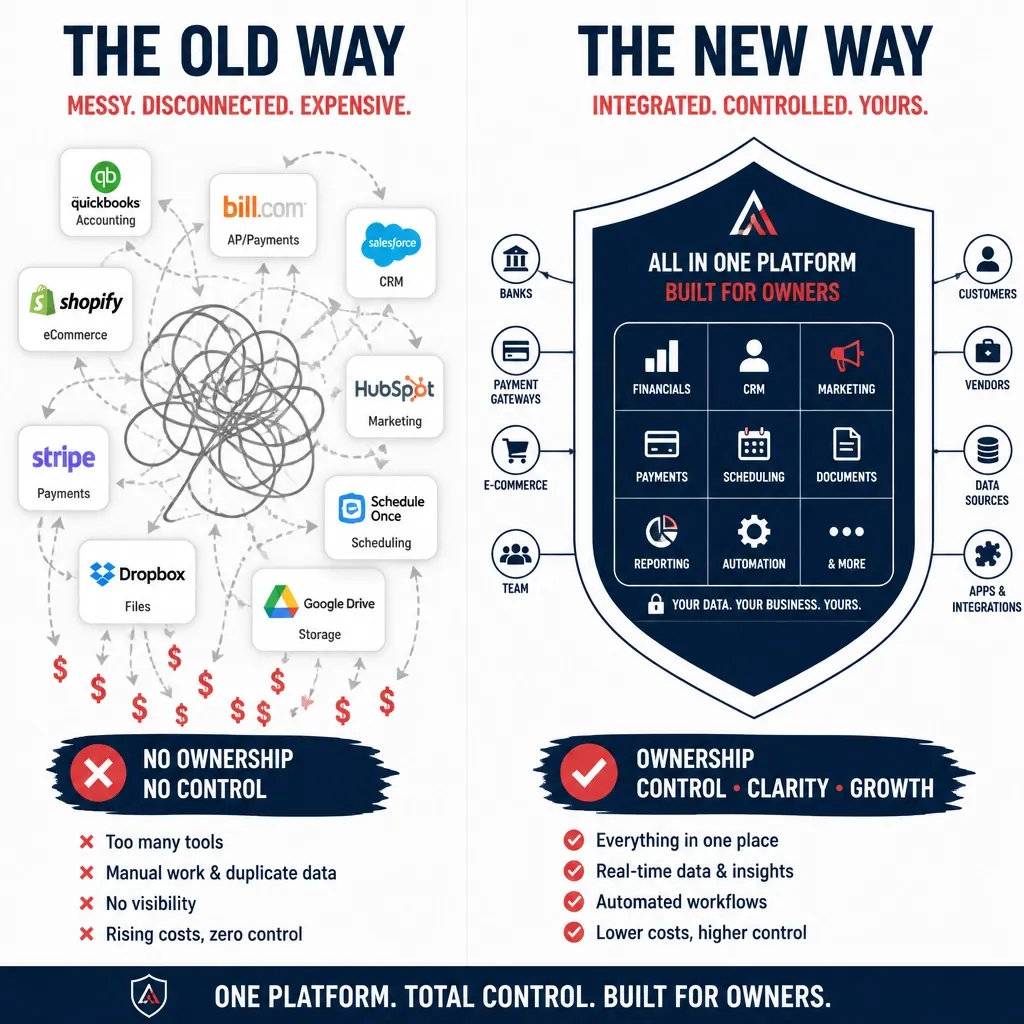
Every subscription you have runs in a data center somewhere. When compute gets more expensive, vendors raise prices or push you up a tier. The more disconnected tools you pay for, the more price increases you are exposed to.
What does not change
You do not need rack space at TierPoint. Colocation is for companies running their own hardware. A business with five or ten people needs reputable cloud tools, clear ownership of its data, and systems that talk to each other. None of that depends on a building in Midtown.
A 20-minute boom check you can do today
Grab a notepad. This is the whole exercise.
- Find your electric rate. Pull your last four utility bills and write down the rate per kilowatt hour, not just the total. Set a reminder to check it each quarter.
- List your software renewals. For every subscription, note the monthly cost, the renewal date and whether it is annual or monthly.
- Flag the annual contracts. Those are where a price increase hits all at once. Put the renewal dates on your calendar 60 days out so you decide on purpose.
- Circle the overlaps. Two tools doing the same job is the cheapest fix available to you.
- Mark the copy and paste. Wherever someone retypes data from one tool into another, write it down. That is labor cost, and it goes up faster than any server bill.
If step five produced a long list, the data center boom is not your biggest cost problem. Your process is.
How I'd approach this
I have been building with AI every day since ChatGPT launched in November 2022, and I keep seeing the same thing. Good people, a product that works, and a process held together with tabs and memory. Rising costs make that worse, but they didn't cause it.
So I start with the single biggest bottleneck, not the news cycle. Usually that means connecting the tools you already pay for with n8n so data moves on its own, then adding AI where it actually saves time. When something needs a database, I set it up in Supabase in a US hosting region under an account you own. You can read how a first month runs on how I work, and see the kinds of jobs I take on at what I automate. If software costs are the bigger worry, start with whether you really need 10 software subscriptions.
Frequently asked questions
Where is Google's Missouri data center?
Google's campus, called Project Spade in planning documents, sits south of Interstate 70 near New Florence in Montgomery County, on former farmland. Google announced it as a $15 billion investment, and the county commission approved a tax incentive package in June 2026. Google expects about 300 workers there once it is running. Construction is already underway.
Is the Midtown St. Louis data center a done deal?
It has its approvals. The city's Land Clearance for Redevelopment Authority signed off on TerraWatt's community benefit plan on September 15, 2026, and construction is planned from August 2027 to late 2029. But several plaintiffs have sued the city to stop it, and those cases were still pending at last report. Approved is not the same as built.
Will the data center boom raise my electric bill?
Nobody can tell you that honestly yet. A Bloomberg analysis found wholesale power prices rose as much as 267% over five years in some areas near data centers, but that is wholesale and covers other markets. Track your own rate per kilowatt hour each quarter so you see a change when it happens instead of guessing.
Will these data centers create jobs in St. Louis?
Some. Google expects about 300 workers in Montgomery County. The Midtown deal requires at least 100 permanent jobs eventually, with about 1,050 construction jobs that are mostly temporary. Data centers are big on capital and light on staff. The bigger local effect is likely on land, power and tax revenue rather than hiring.
Let the headlines be headlines
You can't control what gets built on Market Street. You can control how much of your week disappears into manual work. If you want a second set of eyes on that, book a 30-minute conversation. I'll look at your biggest bottleneck with you and tell you straight whether automating it is worth it. No pitch.